
In 1993, three engineers squeezed into a Denny’s booth in San Jose with coffee and a plan for a chip company.
One of them, Jensen Huang, was 30, married, a father of two, and had scrubbed plates for that same chain as a teenager.
Decades later he told CBS’ 60 Minutes how strange that arc felt: “This is the most extraordinary thing. That a normal dishwasher busboy could grow up to be this. There’s no magic. It’s just 61 years of hard work every single day.” (NBC/CNBC, 2024)
On Thursday, November 12, 2026, Nvidia’s board announced that Huang had resigned as president, chief executive and board member, effective immediately (Nvidia).
Thirty-three years, gone in one press release. I went through the filings, the apology email and two weeks of coverage to piece together how a man who once called Denny’s his “other alma mater” ended up here.
Taipei, Kentucky and a dish rack
Jen-Hsun Huang was born on February 17, 1963, in Taipei.
His mother taught her sons English with ten random dictionary words a day.
At nine, still far from fluent, he was sent to America, and his parents sold nearly all they had to pay for school.
That school was no prep academy. Oneida Baptist Institute in Kentucky was a religious reform school, and his family enrolled him and his brother there without a clue what it was.
At 15 he washed dishes at a Denny’s, got promoted to busboy, and later waited tables.
He still talks about it with something close to pride, as at a 2024 Stanford Graduate School of Business interview: “I planned my work. I was organized. I was mise en place. I washed the living daylights out of those dishes.”
Same interview, same theme. “No task is beneath me,” Huang said. “Remember, I used to be a dishwasher. I used to clean toilets… that’s life. So you can’t show me a task that’s beneath me.” (Entrepreneur, 2024)
Oregon State University handed him an electrical engineering degree in 1984.


Jensen Huang, President of NVIDIA at supermicro keynote during the COMPUTEX 2023 – @Getty
A master’s from Stanford followed in 1992, earned at night while he designed microprocessors at AMD.
He moved to LSI Logic after that, where he met Chris Malachowsky and Curtis Priem, the two men in the booth.
Three engineers and a pot of coffee
Nvidia’s first pitch was simple to say and hard to sell. Huang described it at Stanford: “The PC revolution was just getting going. We thought, why don’t we build a company that solves problems that a normal computer that is powered by general purpose computing can’t.” (Fortune, 2024)
Graphics for games was the first market. It almost killed them.
1997
Sega’s chief at that time, Shoichiro Irimajiri, handed Huang a $5 million lifeline.
With little cash for a second try, Nvidia had one shot to tape out (send a finished design to the factory) a chip called RIVA 128, released in August 1997.


Jen-Hsun Huang, the fiercely competitive CEO of Nvidia – 2003 – @Getty
Huang’s answer to engineers who asked how he knew it would work: “I know it’s going to be perfect because if it’s not we’ll be out of business. So let’s make it perfect.”
It worked.
Nvidia went public in 1999.
Thirty days from the edge, for three decades
From those months came a motto he never dropped: “Our company is thirty days from going out of business.” Most of people would retire a line like that once a firm is worth trillions. Huang did not.
In a GamesBeat interview after Ampere launch he said: “I literally feel, every single morning, that we’re 30 days from going out of business. I wake up in a panic. I’ve got lots of work to do. We have a company to save.”
On Joe Rogan’s podcast in December 2025 the anxiety was still there, word for word:
“The phrase ’30 days from going out of business’ I’ve used for 33 years. The feeling doesn’t change. The sense of vulnerability, the sense of uncertainty, the sense of insecurity, it doesn’t leave you.”
At Columbia Business School he put it shorter: “You’re always on the way to going out of business.”
I find that Rogan line tells me more than any keynote does.
Five trillion dollars and a lecture on suffering
AI changed the math, and Nvidia’s graphics chips moved from gamers’ PCs into data centers.
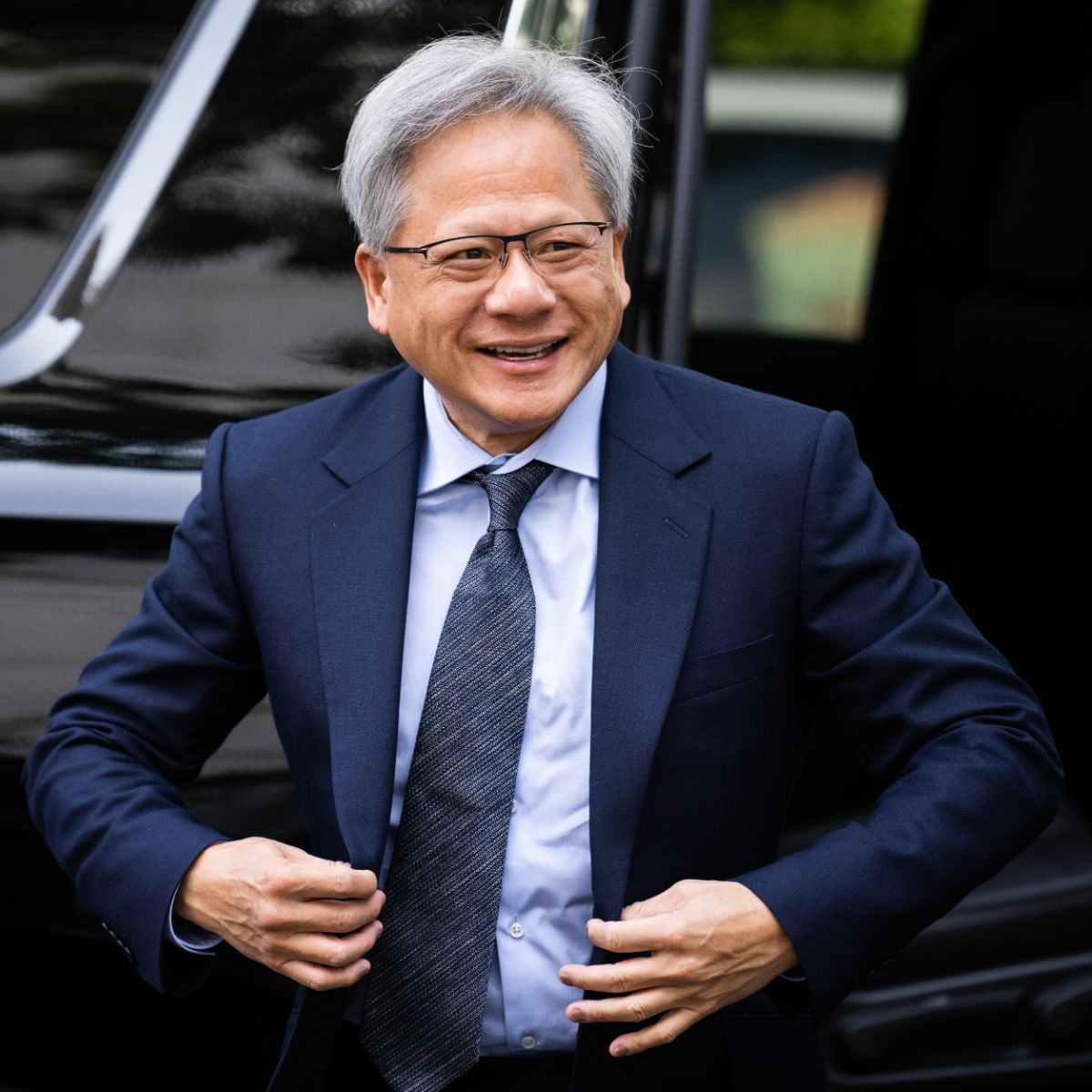
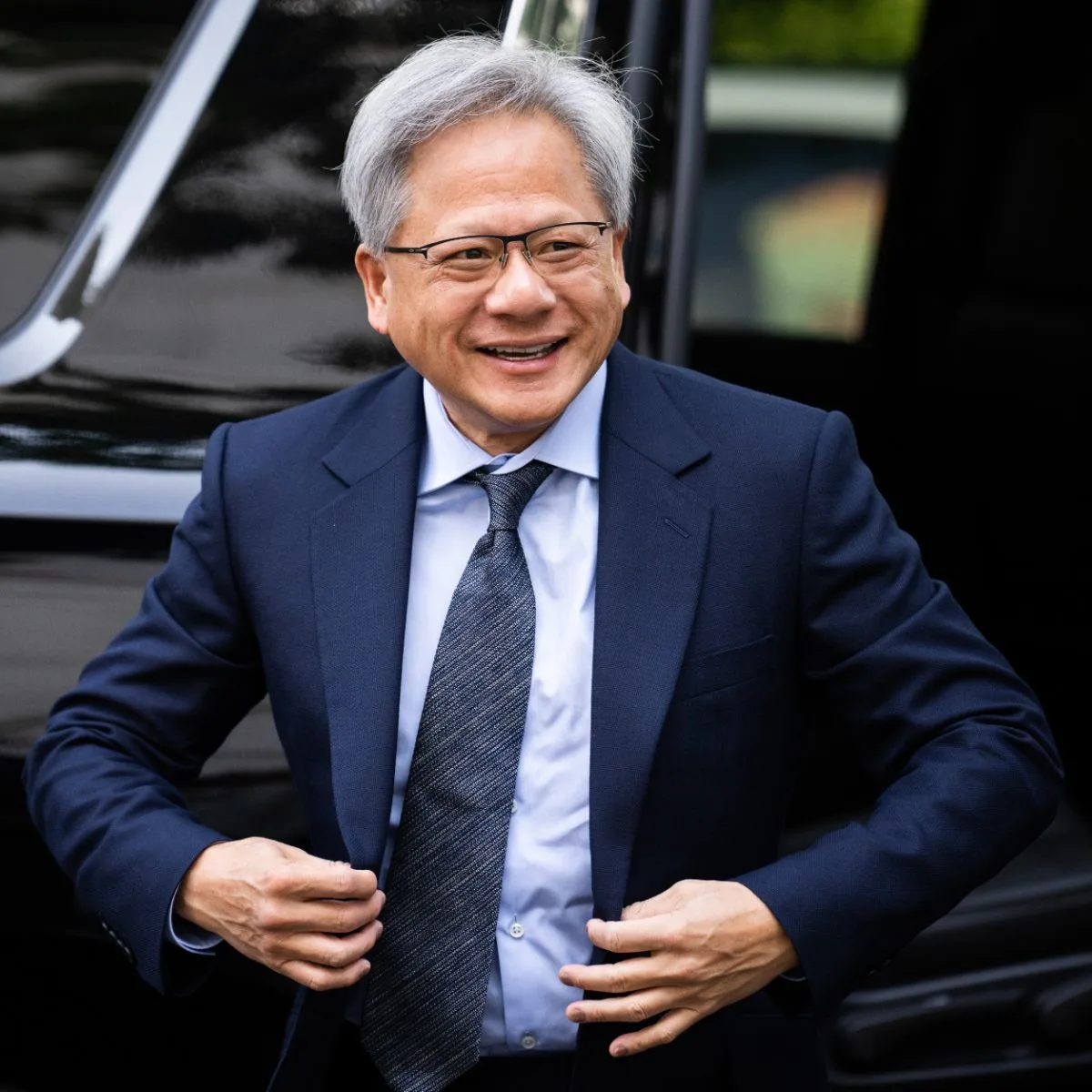
Jensen Huang arrives for the Inaugural AI Insight Forum in Russell Building on Capitol Hill – @Getty
In October 2025 Nvidia became the first company to pass $5 trillion in market value.
At GTC in March 2026 Huang told the crowd in San Jose: “We saw $500B in GPU demand last year for Blackwell and Rubin.”
His management philosophy, delivered to a Stanford audience in 2024.
“People with very high expectations have very low resilience. And, unfortunately, resilience matters in success. I don’t know how to teach it to you … but for all you Stanford students, I wish upon you ample doses of pain and suffering.” (Axios, 2024) He added: “To this day I use the phrase ‘pain and suffering’ inside our company with great glee.”
And at CES in January 2026, asked how long he planned to stay, he joked about tenure in a way that hurts to quote now: “The secret for being CEO for this long is 1, don’t get fired, and 2, don’t get bored. I don’t know which one comes first. How long [will I remain CEO]? For as long as I deserve it.”
Fourteen days in autumn
In October 2025, U.S. and Singapore authorities looked into Megaspeed, a Singapore-based AI infrastructure company, over suspected export violations, and Megaspeed had bought $4.8 billion of Nvidia chips over two years.
In spring 2026 a secret memo went round the Trump administration and warned that a Megaspeed executive, Alice Huang, was a spy for China’s Ministry of State Security.
October 29, 2026. The New York Times revealed that Jensen Huang and Alice Huang had a close relationship. Nvidia spokesperson John Rizzo said at that point: “Jensen’s interactions with Ms. Huang are not unusual or unexpected.”


Jen-Hsun Huang, Co-founder, President and Chief Executive Officer NVIDIA Corporation, poses at outdoor location in Mumbai, India – 2009 – @Getty
November 5. Three House committee chairmen, John Moolenaar, Brian Mast and Rick Crawford, asked Huang for a closed-door briefing and wrote that “Recent reports raise significant national security concerns.”
November 8, a Sunday, was the day denial ended. Huang sent employees an email, published on Nvidia’s newsroom, that opened with “I owe my family and all of you an apology.” The core of it: “I was unfaithful to my wife. My actions hurt her and our children. There is no excuse for what I did. I am deeply sorry.”
Same day, board opened an independent investigation and said it had no reason to believe national security or company secrets were compromised.
President Trump called Huang “a fine person” and said he should stay.
November 9. Huang pulled out of the ElevenLabs Summit and the Anthropic CEO Forum. Nvidia stock fell more than 5%.
November 10. Independent directors hired Joon H. Kim, a former acting U.S. attorney for the Southern District of New York, with the law firm Wachtell, Lipton, Rosen & Katz. Same week, The Information wrote that a Chinese firm called Shanghai Century Litong, an Nvidia-preferred cloud partner that Alice Huang’s family reportedly set up, per TechCrunch, facilitated $7.5 billion in Nvidia chip purchases.
November 11. The New York Times described a second affair, with an Nvidia executive who reported directly to Huang. Neither Nvidia, Huang nor the executive confirmed it. When a Times reporter reached him, Huang said “I don’t think you should be talking to me directly” and hung up.
Later that day the Wall Street Journal said directors were set to oust him. Stock fell about 8% after hours.
That night directors accepted his resignation, per an 8-K (the form a public company files with the SEC to report a major event).
The stock closed Wednesday at $173.73 and opened Thursday at $151.00.
Who is Alice Huang?
First, no relation. Alice Huang is a Chinese citizen. Her Chinese name is Huang Le, per CBS News.
Singapore corporate records list her as a director at Megaspeed International from March to November 2023, and the New York Times described her as a fluent English speaker who moved through industry conferences and executive dinners.
U.S. intelligence agencies concluded she was a Chinese intelligence operative.
That is an intelligence assessment reported through sources. It is not a verdict. CNN reports her whereabouts are unclear and that she has made no public statement.
Megaspeed said on Thursday it will cooperate with the U.S. investigation.
Trump said the FBI also probes romantic and business ties between the two (CBS). Nvidia faces a shareholder class-action lawsuit, per Al Jazeera.
Lori Huang, the wife in the apology
Lori and Jensen Huang met at Oregon State, where she was his engineering lab partner. He married with her in 1985.
They have two children, Spencer and Madison, and both work at Nvidia, Spencer as a product manager and Madison as director of product marketing.


Jen-Hsun Huang with his family – @Getty
The couple runs a charitable foundation together, the Jen-Hsun & Lori Huang Foundation, which has about 58.7 million units of Nvidia stock.
Lori has made no public comment I can find. Huang’s email ended with a request for privacy for his family.
Interim boss, open seat
Colette Kress, CFO since September 2013, is now interim CEO and stays on as CFO.
Her statement: “I am committed to building on the extraordinary foundation Jensen created over the last 33 years.” (SEC filing, 2026)
Harvey C. Jones, a director since 1993 and former Synopsys CEO, became Nvidia’s first board chair. He said the board “has full confidence in Colette and the leadership team.”
Outside reaction went in strange directions.
Trump suggested former Apple CEO Tim Cook should run Nvidia and posted “A Legend to replace a Legend”.
Binance co-founder Changpeng Zhao wrote on X that “it’s a mistake for Nvidia to let Jensen resign”.
Jensen Huang net worth after the fall
Jensen Huang’s net worth is estimated at about $148 billion.
| Date | Estimated net worth | What changed |
|---|---|---|
| May 2024 | Over $100 billion (Forbes) | First time past that line |
| June 2024 | $119 billion (Bloomberg) | Nvidia stock peak |
| September 2024 | $94.9 billion (Bloomberg) | Biggest one-day drop at that point |
| January 2025 | $101 billion (Bloomberg) | DeepSeek selloff, $20.1 billion lost |
| Early November 2026 | Just over $171 billion (Fortune) | Before scandal deepened |
| November 10, 2026 | $148 billion (Bloomberg) | Spy allegations, board probe |
READ THIS NEXT: Draco Malfoy Then and Now: Tom Felton vs Lox Pratt


I am Bulgarea Candin Stefan, and I founded FamousPeopleToday.com in 2018. I’m using my bachelor’s degree in economics and 9 years of experience in blogging to guide millions of people through the incredibly complex world of celebrity net worths.